
BBB Accredited
Licensed & Insured
Free Hail Inspections
Insurance Claim Specialists
Free Hail Damage Inspection — No Cost, No Obligation
Most hail damage isn't visible from the ground. We climb the roof, photograph every impact, and give you a written report you can hand straight to your insurance company — whether or not you hire us for the repair.
How to Tell If Your Roof Has Hail Damage
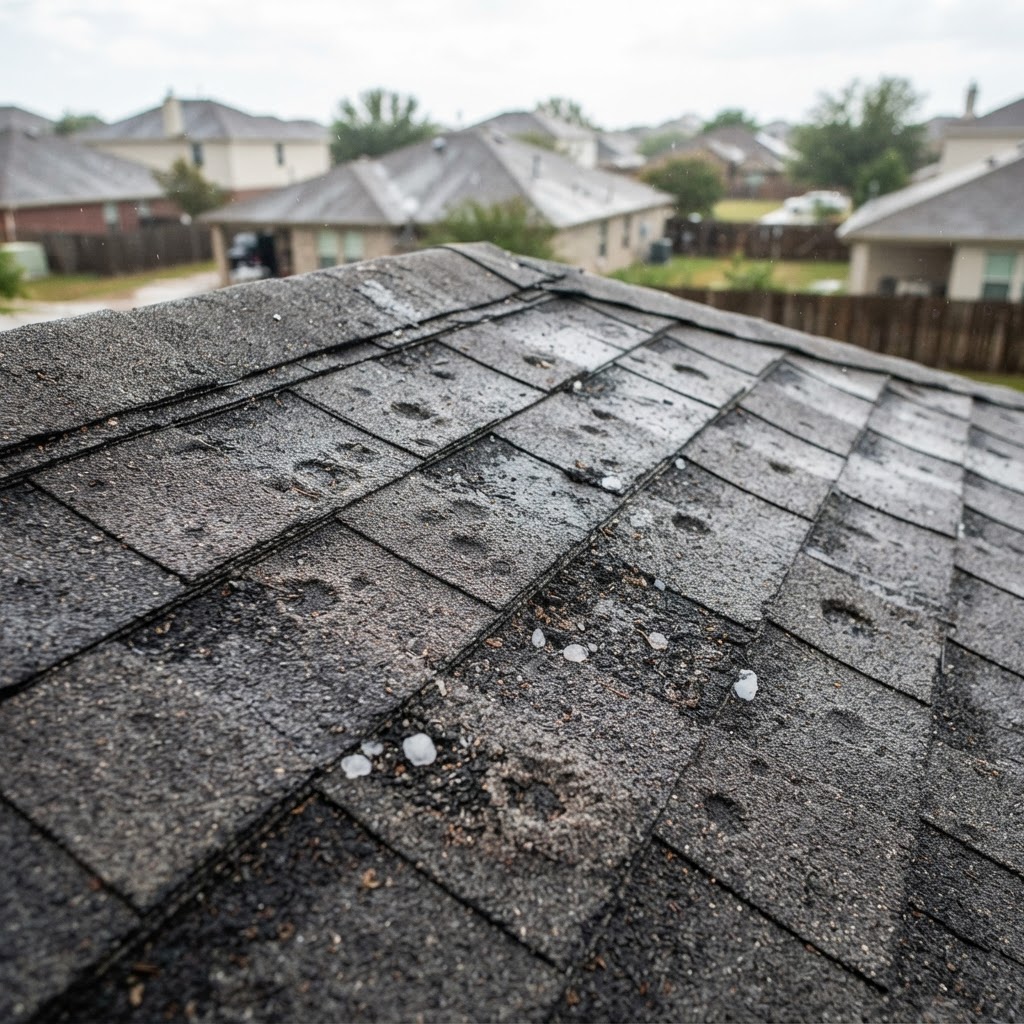
Hail rarely announces itself. A storm passes, the yard dries out, and the roof looks fine from the driveway — but the shingle surface has been bruised, the protective granules have been knocked loose, and the underlying mat is now exposed to UV and water. That damage shortens the life of the roof and eventually shows up as a leak.
The damage is real, but it's subtle — which is exactly why it needs to be documented by someone standing on the roof rather than judged from the driveway.
Why Hail Damage Gets Missed
Hail bruising is a soft-impact injury. Unlike wind damage, it usually doesn't lift or tear shingles, so there's nothing dramatic to see from the ground. Homeowners routinely wait until a leak appears — and by then it's often been seven to nine months, which is long enough for the insurance company to question whether the damage came from the storm at all.
Insurance policies carry deadlines for reporting storm damage. Getting a documented inspection on the calendar soon after a hail event puts the storm date and roof condition on record, even if you decide not to file. The inspection is free either way.
Repair or Full Replacement?
It depends on how widely the hail hit and how old the roof already was. Isolated damage on one slope is often a straightforward repair. Widespread bruising across multiple slopes usually means the shingle surface has lost its protective layer everywhere, and patching will only postpone the real fix.
We tell you which one you're looking at, and we tell you plainly. If a repair solves the problem, that's what we'll recommend — we don't sell replacements to homeowners who don't need them.
- Spot repair — localized impacts, sound underlayment, roof still well within its service life
- Slope replacement — heavy damage concentrated on the storm-facing side
- Full replacement — widespread granule loss, an aging roof, or damage the insurer approves as a total
What Our Hail Inspection Includes
Every hail inspection follows the same process, because that's what holds up when an adjuster reviews it.
- Full walk of every accessible roof slope, not a ground-level look
- Test squares marked and photographed to show impacts per 100 square feet
- Documentation of soft metals — gutters, vents, flashing, and A/C units
- Attic and interior check for moisture, staining, and deck damage
- Written report with dated photos and a clear repair recommendation
- Emergency tarping the same day if the roof is actively leaking
Insurance Claims for Hail Damage
Hail is a covered peril under nearly every standard homeowner's policy in Texas. What decides your claim isn't whether the damage happened — it's whether it was documented well enough to prove. That's the part most homeowners are left to handle alone.
We photograph and measure the damage the way adjusters expect to see it, meet the adjuster on site, and walk the roof with them so nothing gets overlooked or written off as wear and tear.
See how the claim process worksServing the Entire DFW Metroplex
Trinity Roofing & Restoration responds to hail events across Dallas, Fort Worth, Arlington, Grand Prairie, Irving, Mansfield, Plano, Frisco, McKinney, and the surrounding communities. We're local — when a storm rolls through, we're already here.
View all service areasThe Hidden Damage Problem
You Can't See the Worst of It From the Ground
Granule Loss
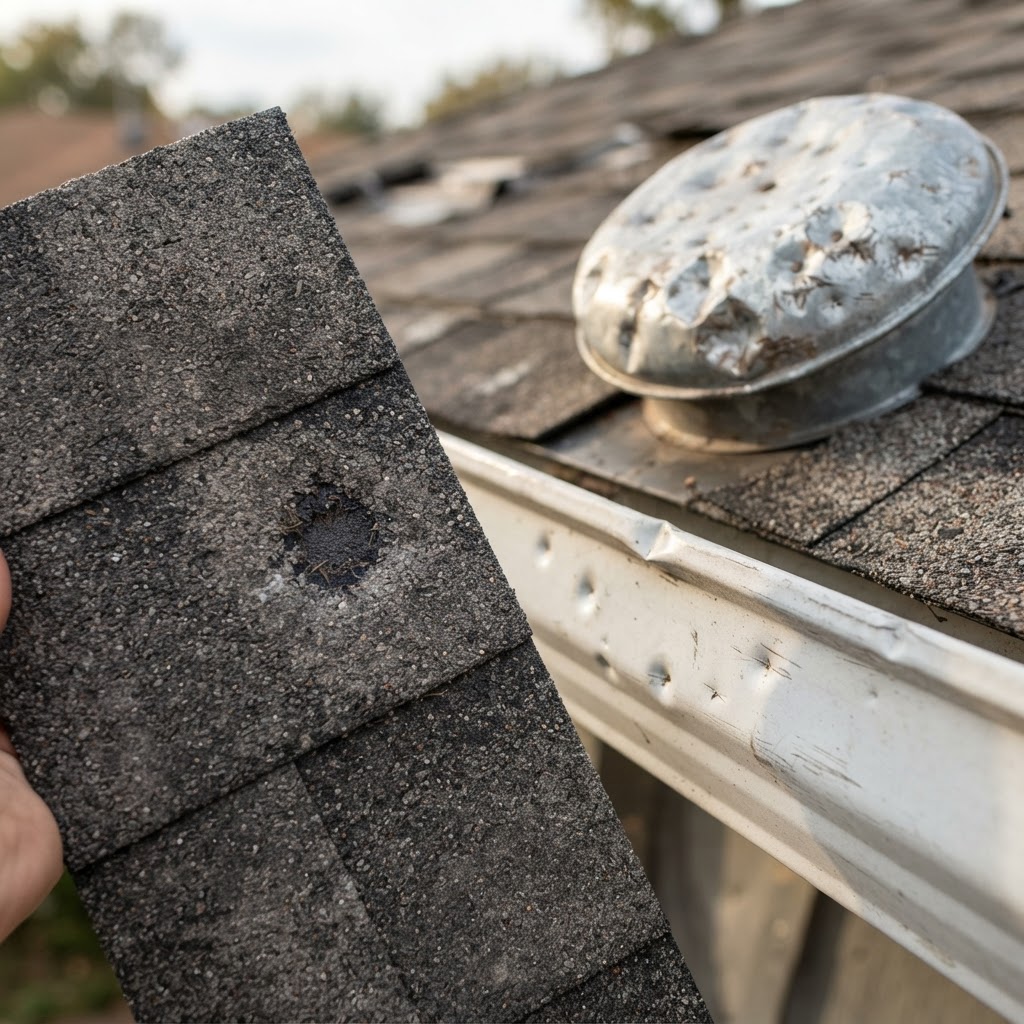
The granules on your shingles are the sunscreen for the asphalt underneath. Hail knocks them loose in bruised patches you can't see from the driveway. Once they're gone, UV exposure starts aging that shingle years faster than the rest of the roof.
Mat Fractures
A hailstone can crack the fiberglass mat inside a shingle without breaking the surface. The roof looks intact, holds water for a season or two, then begins leaking — often seven to nine months after the storm that caused it.
Flashing & Gutter Damage
Soft metals take hail the hardest. Dented gutters, bruised vent caps, and deformed flashing break the seal at the exact points where your roof is meant to shed water, and they're routinely left off inspection reports.
Hail Damage Checklist
8 Signs Your Roof Took Hail Damage
If you can check even one of these, it's worth getting on the roof. Stay on the ground — we'll do the climbing.
Granules in your gutters
Sandy black grit collecting in gutters or at the bottom of downspouts.
Dented gutters or downspouts
Soft metal dents are the clearest ground-level proof hail actually hit your home.
Dark spots on shingles
Bruised patches where granules were knocked off, exposing the black mat beneath.
Missing shingle tabs
Pieces cracked or knocked loose entirely, most often on the storm-facing slope.
Water stains on ceilings
Brown rings or damp patches indoors, sometimes months after the storm.
Dimpled vent caps
Pockmarked turbine vents, ridge vents, and A/C condenser fins.
Cracked skylights
Chips, spider cracks, or new leaks around skylight flashing.
Neighbors getting new roofs
If crews are working your street, the same storm cell hit your roof too.
The Claim Process
From Storm to Finished Roof in 5 Steps
Free Inspection
We walk every accessible slope, mark test squares, and photograph each impact — plus gutters, vents, and flashing.
Damage Report
You get a written, dated report with photos and measurements laid out the way an adjuster expects to review it.
File Your Claim
We show you exactly what to send your insurer and when, so nothing gets missed and no deadline slips past you.
Meet the Adjuster
We're on the roof with your adjuster, walking the damage together so real hail hits don't get written off as wear and tear.
Repair & Restore
Once the claim is approved, our crews complete the repair or replacement and clean the property thoroughly before leaving.
What It Costs You
On an Approved Claim You Pay Your Deductible. That's It.
Example — $1,800 Deductible
Illustrative example only. Your actual amounts depend on your policy, deductible, and the scope your insurer approves.
- Your inspection and written damage report are free, whether or not you file a claim.
- No upfront payment — we don't ask for money before your claim is approved.
- Texas law requires you to pay your deductible. Be cautious of any contractor offering to waive, absorb, or 'eat' it — that's illegal, and it puts your claim at risk.
- Hail is an act of nature, not an at-fault claim, so filing doesn't raise your individual rate the way a fault-based claim would.
Hail Damage Reviews
What DFW Homeowners Say After the Storm
Two other companies looked at our roof from the driveway and said it was fine. Trinity got up there, marked test squares, and found close to 200 hail hits. The photos made the whole conversation with our insurance company simple.
Melissa R.
Arlington, TX
Our adjuster counted about 40 impacts. Trinity walked the roof with him and documented 180. That difference is the reason we ended up with a full replacement instead of a patch job.
James T.
Fort Worth, TX
Everybody focused on the shingles and completely missed our gutters. Trinity photographed every dent in the gutters and vent caps, and those got included in the claim too.
Dana W.
Mansfield, TX
Materials Matter — Here's Why
We Don't Cut Corners On Materials
Here's something most roofing companies won't tell you: the cheapest quote usually means the cheapest materials. And the cheapest materials don't last in Texas.
DFW weather is brutal on roofs — 100+ degree summers, hail season, wind storms, and sudden temperature swings. Cheap shingles crack. Cheap underlayment tears. Cheap flashing rusts. And two years later, you're calling someone to fix what should have lasted 20.
We don't play that game. Every Trinity Roofing job uses quality materials — the kind built to hold up to Texas heat, hail, and wind. We could buy cheaper stuff and offer the lowest quote in DFW. We choose not to. Here's what that means for you:
- Your roof lasts longer — quality shingles and components mean 20-25 years, not 8-10
- Your warranty is real — manufacturer warranties only apply when quality materials are installed correctly
- Your home is actually protected — cheap materials fail when the next storm hits
- Your investment holds value — a quality roof adds resale value; a cheap roof is a red flag for buyers
We're not the cheapest roofer in DFW, and we don't want to be. We're the one you call when you want it done right — with materials that will still be protecting your home 20 years from now.
You're not just buying a roof. You're buying peace of mind for the next two decades.
Frequently Asked Questions
How soon after a hailstorm should I get my roof inspected?
As soon as you can, ideally within a few weeks. Insurance policies limit how long you have to report storm damage, and the longer you wait, the harder it becomes to prove the damage came from that specific storm rather than ordinary aging.
How big does hail have to be to damage a roof?
Hail around one inch — roughly a quarter — can bruise asphalt shingles, and smaller hail driven by high wind can do it too. Damage depends on shingle age, material, and impact angle as much as stone size, which is why a physical inspection beats guessing from a weather report.
Will filing a hail claim raise my insurance rates?
No — hail damage claims are considered acts of God, so your individual claim can't raise your premium on its own. Area rates may go up after a widespread storm whether you file or not, so having the damage documented costs you nothing.
What does hail damage repair cost me out of pocket?
If the claim is approved, your out-of-pocket cost is generally your policy deductible. We assess the roof first — if the damage won't justify meeting your deductible, we tell you before you commit to anything. We provide the estimate and documentation your insurer needs, and we'll walk you through exactly what's covered before any work begins.
Can you tarp my roof if it's leaking right now?
Yes. We offer 24/7 emergency response across DFW, including same-day tarping and leak stops to keep water out while the claim and repair are being sorted out.